
Websites, AI & the New Era of Business Responsiveness
For many businesses, a website is still viewed primarily as an online brochure — a place to display services, contact details, and opening hours. In reality, websites now sit much closer to the centre of business operations, marketing strategy, customer experience, and increasingly, automation. In Australia’s competitive and fast-moving business environment, a website is no longer simply about “being online.” It influences how a business is discovered, how quickly it responds, how professionally it is perceived, and how effectively it converts interest into enquiries, bookings, or sales. As digital expectations continue evolving, understanding the foundations of websites — and how emerging technologies such as AI integrate into them — is becoming increasingly important for organisations of all sizes.
“The conversation is shifting from simply being online to how effectively a business functions within digital environments.”
Understanding the Foundations
A domain name is the web address people type into a browser to find a website, such as:
Domains act as a digital identity and navigation point for a business online. Rather than remembering a string of numbers known as an IP address, users access websites through readable names. In simple terms, a domain can be thought of like a business’ digital address or property location — the place customers go to find you online.
Hosting, on the other hand, is the infrastructure that keeps the website operating and accessible. Much like council rates or utilities supporting a physical premises, hosting ensures the website remains live, secure, and functional.
Together, domains and hosting form part of a business’ broader digital identity — not simply its organisational presence online.
Choosing the right domain matters because it contributes to:
brand recognition
trust
search visibility
memorability
long-term scalability
Different domain endings — known as extensions or TLDs (top-level domains) — serve different purposes.
A .com.au domain is generally used by Australian commercial businesses and usually requires an ABN or ACN. For many Australian organisations, it reinforces local trust and legitimacy. A .com domain is more globally recognised and is often chosen by businesses intending to scale internationally or position themselves beyond a local market. Extensions such as .org or .org.au are commonly associated with charities, associations, and community organisations.
While there are now hundreds of domain variations available, simplicity and clarity often remain the strongest long-term strategy.
Importantly, websites are not simply one-time purchases. Much like maintaining a vehicle, digital infrastructure requires ongoing upkeep to remain functional, secure, and effective over time.
Annual costs may include:
domain renewals
hosting
platform subscriptions
business email services
security certificates
maintenance and updates
booking or CRM integrations
SEO and performance optimisation
content creation and management
Poorly designed and maintained websites can quietly contribute to lost enquiries, reduced trust, weaker search visibility, and operational inefficiencies over time.
Subdomains and Digital Flexibility
As organisations grow, many begin separating functions across subdomains — extensions added before the primary domain name, such as:
Subdomains allow organisations to create dedicated sections without necessarily building entirely separate websites.
For community groups, charities, and sporting clubs, subdomains can also offer a more affordable and manageable solution. Rather than registering and maintaining multiple standalone domains — each with their own renewal fees, hosting arrangements, and administrative overhead — organisations may operate several functions beneath a single primary domain.
For example, a regional sporting club may maintain:
a main website for general information
a subdomain for registrations and fixtures
another for sponsors or community announcements
This allows the organisation to centralise branding and reduce costs while still expanding functionality over time.
Subdomains are also increasingly useful for:
member portals
booking systems
educational platforms
event pages
internal business systems
local campaigns or initiatives
The Story Behind User Experience (UX)
One of the most discussed concepts in modern website design is UX, or user experience.
At its core, UX refers to how people interact with and experience a website. Good UX is not simply about visual appearance — it is about clarity, ease, responsiveness, trust, and reducing friction between the visitor and the action they are trying to take.
A website with poor UX may:
load slowly
feel cluttered
confuse users
hide important information
overwhelm visitors with choices
In contrast, strong UX helps visitors move naturally through a website with confidence and minimal frustration.
As digital expectations continue evolving, users increasingly gravitate toward online experiences that feel clear, intuitive, and effortless to navigate. Research into consumer digital behaviour continues to show that website usability, speed, and responsiveness significantly influence trust, engagement, and purchasing behaviour (Google Australia, 2023; HubSpot, 2024).
Good UX often involves:
mobile-responsive design
clear navigation
fast loading times
accessible layouts
intuitive calls-to-action
streamlined enquiry pathways
Search engine optimisation (SEO) also plays an important role in how websites are discovered online. SEO refers to the process of improving a website’s visibility within search engines through factors such as site structure, content quality, loading speed, mobile usability, and relevance. Increasingly, well-designed websites are expected to perform seamlessly across both desktop and mobile environments, as mobile responsiveness now forms a core part of both user experience and search visibility (Google Australia, 2023).
Importantly, websites that prioritise thoughtful funnel design are often more than simply functional. They create space for businesses to communicate their values, positioning, and identity in ways that feel natural, cohesive, and easy for users to engage with.
QR Codes and the Expanding Digital Layer
QR codes have become increasingly integrated into everyday business operations across Australia.
Originally used primarily for quick website access, QR codes are now commonly used for:
digital menus
event registrations
contactless payments
reviews
social media links
downloadable brochures
loyalty programs
donations
practitioner profiles
appointment bookings
On business cards, QR codes can instantly direct users toward booking systems, contact pages, payment gateways, or portfolio examples.
For community organisations and charities, QR-enabled donations and registrations have also simplified fundraising and participation processes.
The broader shift is important: websites are no longer isolated destinations. They increasingly sit within interconnected digital ecosystems linking physical and online experiences together.
Websites as Operational Systems
Modern websites now function far beyond digital brochures. Increasingly, they operate as business systems capable of supporting communication, administration, customer service, and lead management simultaneously.
Today, websites may:
automate bookings
capture and qualify enquiries
process payments
distribute forms
trigger workflows
support customer communication
integrate with CRM platforms
facilitate AI-driven automation
For businesses operating in competitive sectors, responsiveness itself is becoming a strategic advantage. A delayed response may no longer simply mean inconvenience — it may mean the customer chooses another provider entirely.
The evidence is increasingly reflecting this shift. Australian businesses continue expanding investment into digital capability, automation, and AI-supported workflows as customer expectations around speed, accessibility, and communication continue evolving (ABS, 2024; Deloitte, 2024).
“Responsiveness is increasingly becoming part of the customer experience itself.”
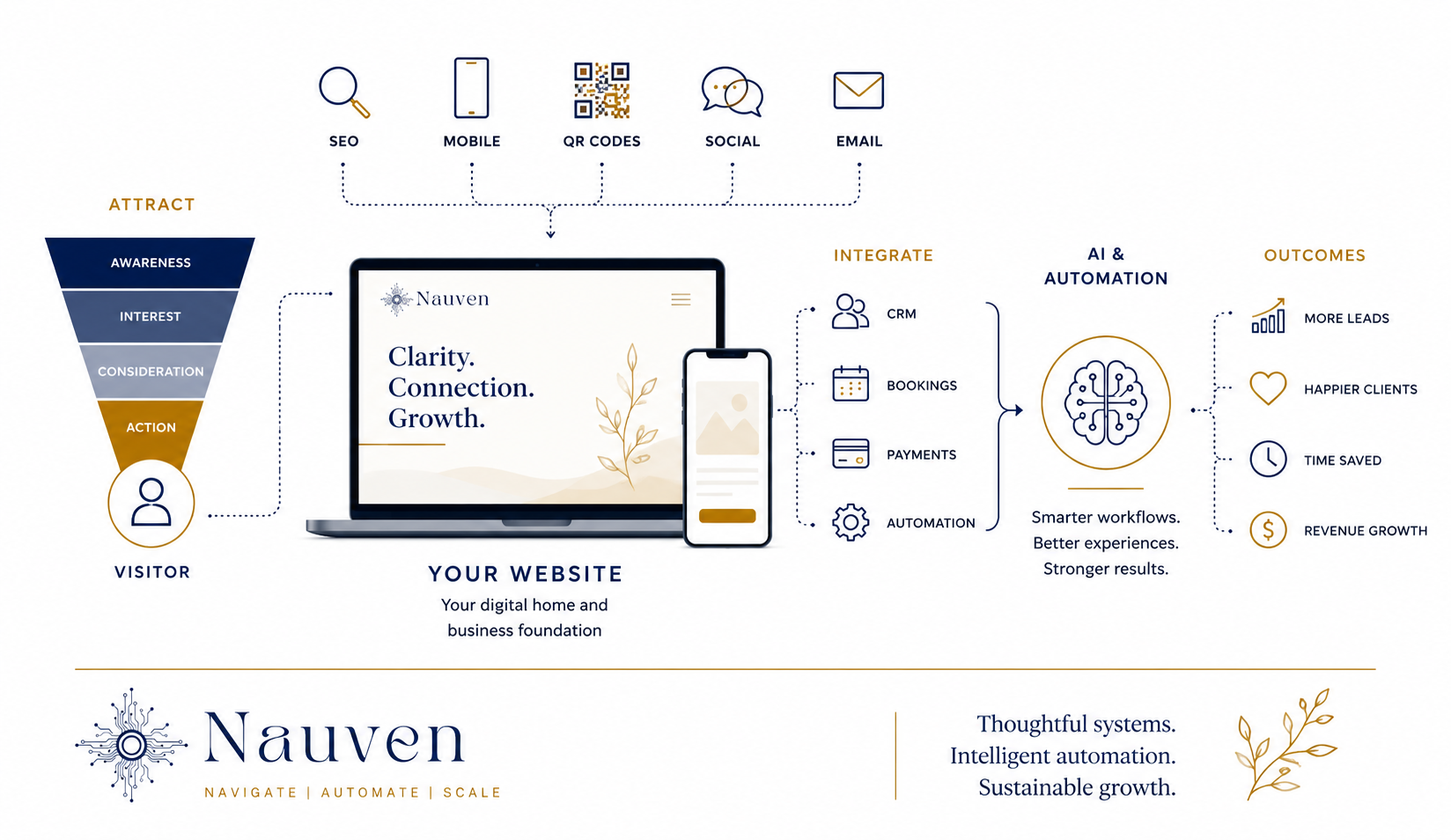
Modern websites increasingly operate as interconnected business systems supporting communication, automation, responsiveness, and customer engagement.
AI, Funnels, and Business Responsiveness
Artificial intelligence is rapidly reshaping how businesses engage with customers online.
From AI-assisted chat systems to automated enquiry routing and intelligent workflows, websites are increasingly becoming responsive environments capable of supporting businesses beyond standard operating hours.
Importantly, AI is not replacing professional expertise. Rather, it is helping organisations:
respond faster
structure information more effectively
reduce repetitive administration
improve communication consistency
capture opportunities that may otherwise be missed
When implemented thoughtfully, AI can strengthen both operational efficiency and customer experience simultaneously.
A well-designed website should not simply attract visitors — it should guide them toward meaningful action aligned with the business’ objectives.
Importantly, websites that prioritise thoughtful funnel design are often more than simply functional. They create space for businesses to communicate their values, positioning, and identity in ways that feel natural, cohesive, and easy for users to engage with.
Different industries require different digital pathways depending on customer behaviour and operational goals.
Trades and Service Businesses
For trades, speed and simplicity are critical.
A plumbing or electrical business may prioritise:
click-to-call functionality
mobile-first layouts
emergency contact pathways
quote request forms
rapid follow-up systems
An effective funnel may focus on:
Immediate trust
Fast contact
Clear service categories
Structured follow-up
AI-enhanced systems can further support this by categorising enquiries, collecting photos or job details, scheduling callbacks, and automating confirmations.
Real Estate Agencies
Real estate businesses often rely on long-term engagement and database growth.
Funnels may focus on:
appraisal requests
property alerts
downloadable market reports
segmented lead nurturing
automated follow-up campaigns
In this environment, websites function less as transactional tools and more as relationship-building ecosystems.
Finance and Professional Services
Finance businesses generally require strong trust signals and clear information architecture.
Funnels may prioritise:
educational resources
consultation bookings
secure enquiry systems
calculators and assessment tools
credibility indicators
Because decision-making cycles are often longer, websites in this sector benefit from balancing professionalism with accessibility and clarity.
Community Groups and Sporting Clubs
For community organisations and sporting clubs, websites increasingly support communication, registrations, fundraising, sponsorship visibility, and member engagement.
Funnels in this context may focus on:
volunteer sign-ups
player registrations
event participation
sponsor exposure
donations
community announcements
A local football club, for example, may use QR codes on posters or merchandise to direct supporters toward registrations, fixtures, sponsorship opportunities, or fundraising campaigns. Combined with simple mobile-responsive design and social integration, even smaller organisations can significantly improve engagement and administrative efficiency.
Websites as Strategic Infrastructure
As technologies continue evolving, websites are increasingly becoming integrated operational infrastructure rather than optional marketing assets.
Businesses that invest time in understanding these systems — even at a foundational level — often place themselves in a stronger position to adapt as digital technologies continue evolving. Increasingly, well-designed digital systems are influencing far more than visibility alone. From intuitive website navigation and timely communication to automated workflows that reduce friction and streamline customer interactions, these systems can quietly shape trust, responsiveness, conversion, and operational efficiency simultaneously.
In many cases, the businesses performing strongest online are not necessarily the loudest — but the ones creating smoother, more reassuring experiences for the people engaging with them.
Importantly, adopting new technologies should not occur simply because they are trending. Effective implementation still requires thoughtful analysis, alignment with business goals, and consideration of long-term operational value.
There is also value in discernment. Not every business needs to adopt every emerging technology immediately. However, maintaining awareness, remaining adaptable, and understanding how digital systems influence customer behaviour is becoming increasingly important in preserving relevance and competitiveness over time.
Ultimately, effective digital infrastructure is not simply about appearance. It is about communication, responsiveness, operational clarity, and creating systems that support both business growth and customer experience in an increasingly connected world.
Sources:
Australian Bureau of Statistics (2024) Characteristics of Australian business: Use of information technology and digital services. Canberra: ABS.
Australian Small Business and Family Enterprise Ombudsman (2023) Digital capability and Australian small business competitiveness. Canberra: ASBFEO.
Deloitte (2024) State of Generative AI in the Enterprise. Deloitte Insights.
Google Australia (2023) Consumer Expectations and Digital Experience Trends in Australia. Sydney: Google Australia.
HubSpot (2024) The State of Marketing and Lead Generation Report. Cambridge, MA: HubSpot Research.
Statista Research Department (2024) Digital consumer behaviour and online engagement trends in Australia. Hamburg: Statista.